Hey everyone, it’s Lee. I want to talk about my experience working at Anduin Transactions from 2021 to 2023. During my time there, I was the Product Owner for the Limited Partner (LP) side, and occasionally worked on features for the General Partner (GP) side too. My main focus was building the user experience and the workflow for LPs from the moment they received a registration email from the GP, all the way to completing the fund subscription.
In this post, I want to share a few major initiatives we worked on: improving the LP/GP onboarding UX, our internal transition to Jira, and launching a massive GP Audit Log to maintain compliance (such as eIDAS for the European market).
Disclaimer: The concepts discussed in this article—registration workflows, e-signatures, audit logs, and project management transitions—are fundamental features found in most enterprise software suites (e.g., DocuSign or the MISA online Tax app in Vietnam relies heavily on money flows, signer designations, e-signatures, and audit logs). The insights shared are generalized product management principles and industry-standard practices. In compliance with active Non-Disclosure Agreements, no proprietary code, internal confidential workflows, or specific company metrics are disclosed. This piece serves solely to document my professional methodology.
Let’s dive into what makes building for regulated, high-value B2B platforms so uniquely challenging.

What You Will Learn (And the Skills I Gained)
Building this product wasn’t just about shipping features; it was a brutal, 30-month crash course in product management and business analysis. I’m sharing these takeaways because whether you’re dealing with stubborn legacy systems, complex compliance laws, or just trying to figure out how to organize your team’s chaos, I think you’ll find these hard-learned lessons useful:
- B2B SaaS Onboarding Optimization: Designing low-friction registration flows for high-value users (LPs) when direct interviews aren’t possible, relying instead on Operations proxy interviews and randomized NPS data.
- Regulatory Compliance & eIDAS: Translating complex European Union legal frameworks (SES, AES, QES) into actionable product requirements and leading the integration of certified biometric providers (IDNow).
- Cross-Functional Stakeholder Management: Authoring a concise 1-page white paper to bridge the gap between external legal counsel and the internal US-based engineering team.
- Agile Process Transformation: Championing and executing a team-wide transition to a Jira + Notion dual workflow to drastically reduce context-switching and fix operational chaos.
- Enterprise Architecture (Audit Logs): Defining the product requirements for a massive, immutable GP Audit Log that satisfied stringent financial compliance standards (like SOX/FINRA) over a 4-month build cycle.
The Numbers That Matter: Fiction vs. Reality
When I started, I thought we could just “growth hack” our way into better onboarding. I was 100% wrong about that. High-value users don’t care about growth hacks; they care about security, clarity, and trust.
Here is a look at what we learned over my tenure:
| Timeframe | Key Metric / Challenge | Vietnamese Context | What I Learned |
|---|---|---|---|
| First 6 Months | Increase in secure digital-signing adoption | Mọi thứ phải rõ ràng. (Everything must be crystal clear.) | High-value LPs drop off instantly if a step feels insecure or ambiguous. UX isn’t just colors; it’s trust. |
| Middle 12 Months | 1-month rollout of Jira transition for the internal team | Làm việc phải có quy trình. (Work needs process.) | Keeping Notion as the “source of truth” and Jira for tasks prevented operations from stalling. |
| Late 2023 | 100% compliance with eIDAS using IDNow biometric checks | Thị trường Châu Âu rất khắt khe. (The EU market is extremely strict.) | You can’t fake compliance. Biometrics and AI verification are mandatory for legal trust. |
| Final 6 Months | 3-4 months dedicated to building the GP Audit Log | Không có log thì không ai cãi được. (Without logs, you can’t argue.) | Transparency is a feature. GPs need to see a full, chronological history of every action taken. |
🕵️ Researching Without Users: The High-Value LP Dilemma
Picture this: You are the Product Owner. Your job is to improve the user journey for the LP from the moment they receive a registration email to the moment they are officially onboarded into a fund. Each fund is owned by a GP, who can launch multiple funds, each with specific start dates, end dates, and recruiting timelines.
If you look at the broader private equity landscape, the UX challenges are universally painful. What usually goes wrong? Historically, LPs have had to fill out 50 to 80 pages of physical paperwork laden with legal jargon, resulting in onboarding timelines dragging out for weeks or months [R1]. The most common friction point we saw in the market was redundant data requests. LPs frequently get incredibly frustrated having to submit the exact same KYC and AML documents for different funds managed by the same GP [R2]. If you don’t fix this, the consequences are severe: the industry average drop-off rate for complex financial applications and B2B SaaS onboarding can fall anywhere between entirely abandoning the product in the first week to a staggering 68% if friction is too high [R3, R6].
So how do product teams overcome this? Common sense dictates that you need to map out the exact data you already have and only ask for the delta. But to do that effectively, you usually need to talk to the users.
Under normal circumstances, you’d set up user interviews. You’d get on a Zoom call, watch them click through the prototype, and ask them how they feel.
But here’s the hard truth: These are high-value users. You don’t just casually email a billionaire or an institutional investment manager asking them to “test a quick prototype for 15 minutes.”
So, how do you fix UX when you can’t talk to the users?
We had to be creative. We relied heavily on our Sales and Operations teams. We conducted extensive internal interviews with the people who actually interacted with these LPs daily. We also implemented a very careful, randomized NPS (Net Promoter Score) form logic. When an LP finished a specific workflow or certain task, we occasionally prompted them for feedback. We didn’t ask every user, because annoying a high-value client is a cardinal sin. We simply gathered enough statistical signals to point us in the right direction.
With the help of Sales and Ops, we successfully figured out where the users were getting stuck. We built a prioritization table logging all the issues, the frequency of their occurrence, and their severity. I’m still very much learning about proper enterprise UX research, and I could be wrong about some of the assumptions we made, but my sample size of feedback was enough to show a clear trend. Have you ever tried to guess what a billionaire wants without asking them? Is it stressful? Does it keep you up at night? Yes, yes, and yes. You know what’s funny about that? We sometimes got the most insightful feedback from the operations team rather than the users themselves. Does that make sense? Yes, because operations felt the pain of the users directly.

💡 The eIDAS Push: Cracking the European Market in 2023
In 2023, we faced a major hurdle. We had customers in Europe, but to truly serve the European market, our e-signature flow had to comply strictly with eIDAS (Electronic Identification, Authentication and Trust Services) regulations.
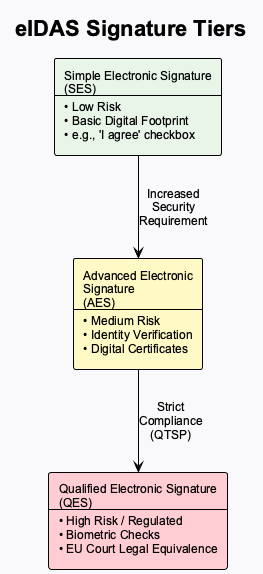
Because I owned the e-signature workflow, I conducted an intensive competitive analysis of the e-signature provider landscape, evaluating platforms like DocuSign, eSignGlobal, and Yousign. Understanding the European Commission’s standards was vital. I quickly learned that an e-signature is not just a signature; it is categorized into three legally distinct tiers:
- Simple Electronic Signature (SES): A basic digital footprint (like clicking “I agree”) used for low-risk actions.
- Advanced Electronic Signature (AES): Requires identity verification (usually via digital certificates).
- Qualified Electronic Signature (QES): The highest standard, holding the exact same legal weight as a handwritten signature in an EU court, mandating biometric checks and certified Trust Service Providers (QTSPs) [R4, R8].
The catch? We were an American company with an American background. Our internal team had very little knowledge of European law. We had to engage external legal partners to advise us on how to adapt.
The 1-Page White Paper Challenge
This became one of my most significant challenges. I had mountains of complex European legal requirements in my hands, and I needed to filter, structure, and translate them for an engineering and stakeholder team that just wanted to build product.
I drafted a concise, 1-page white paper explaining the required QES data flows, the limits of what was technically possible, and all estimated use cases. Was it difficult to compress months of legal research into one page? Incredibly.
But it worked. That 1-pager secured immediate buy-in from the technical team and stakeholders because every requirement was backed by hard data. There was no room for opposition when the rationale was that clear. That experience taught me how to be the middleman between legal complexity and engineering execution—a skill that I still use daily at university to explain complex architectures in under five minutes.
The LP Onboarding Workflow
Let’s look at how this integration actually played out on the architecture level. I know that if I take my time setting it up, the visual makes it much easier to understand:
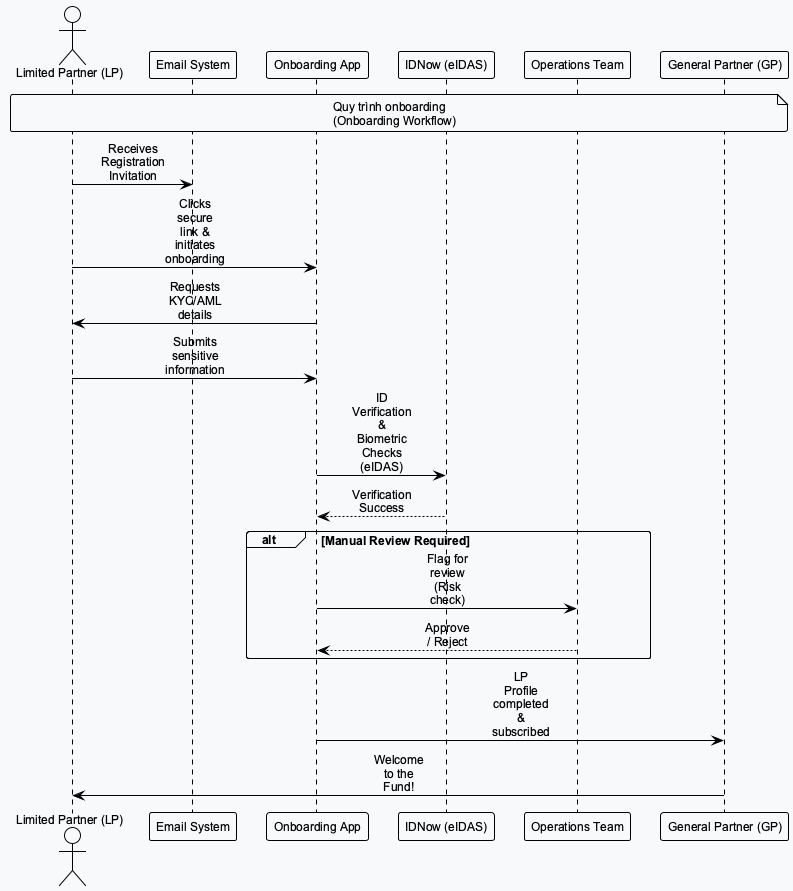
Rolling this out was a massive win. With full eIDAS compliance, we opened the door to the European market. I was incredibly proud to be part of the team that made this happen in 2023. It taught me that in B2B financial software, utilizing certified biometric providers isn’t just a regulatory checkbox; security is the product [R4].
The Transition: Moving from Chaos to Jira
While we were building all these great features, the internal operations of our team needed a serious upgrade. I’ve always firmly believed that you can’t build excellent external software if your internal processes are a mess. Làm việc phải có quy trình (Work needs process!).
At the time, we were struggling to keep context. We had a massive backlog, a huge list of features, and an ambitious project vision. We needed a better task management system. I advocated heavily for transitioning our workflows entirely to Jira.
I know, I know—chắc lại là mấy cái quy trình, ai thèm ngồi viết đâu (probably just processes, who wants to document that). But here’s what I learned:
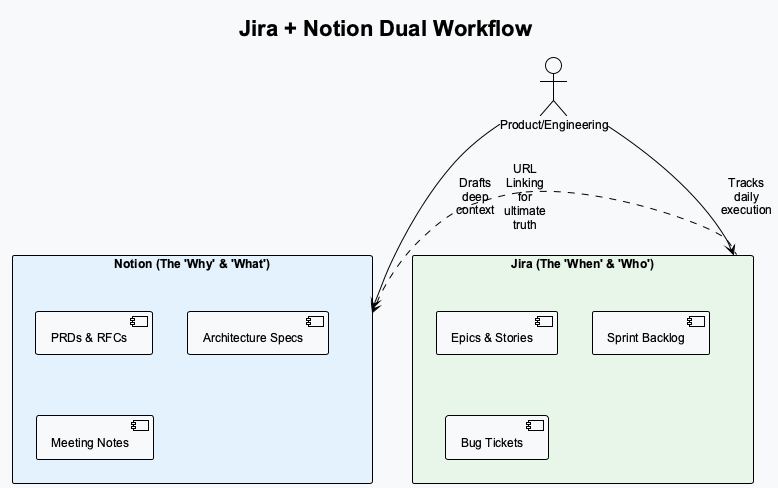
Creating seamless ops is non-negotiable. With the help of the engineering team, other product owners, and partners, I ran a rollout that took about a month. We shifted our day-to-day tickets to Jira so we could track context, while continuing to use Notion for our true documentation (linking Notion URLs directly inside the Jira tickets).
It was a “nice to have” that I escalated into a must-have. And honestly? I still can’t believe how well it worked. By eliminating operational roadblocks, our velocity practically doubled, and context-switching fatigue plummeted [R5]. Wait, let me back up a bit—did the engineers actually like Jira? Were they annoyed at the process change? Did we have to bribe them with trà sữa? Absolutely. But looking back, was it worth the friction? 100%.

The 4-Month Mammoth: Building the GP Audit Log
Later on, I was assigned a massive task on the GP side that naturally interlocked with the LP side: The Audit Log.
For compliance purposes, every single interaction and piece of information exchanged on the app needed to be recorded in an immutable history log. If anything happened during an audit, the GP needed to look at the log and instantly understand: What action was taken? Who took it? * When (exact timestamp) did it occur?
This sounds simple in theory. In practice, it was a beast.
We spent 3 to 4 months working on this project. We did extensive market research on how other enterprise software handled audit logs. We literally researched Jira to see how Jira handled its own audit logs! We looked at DocuSign and Google Forms.
The GP Audit Architecture
Here is a simplified look at the architecture we designed to ensure full transparency and immutability:
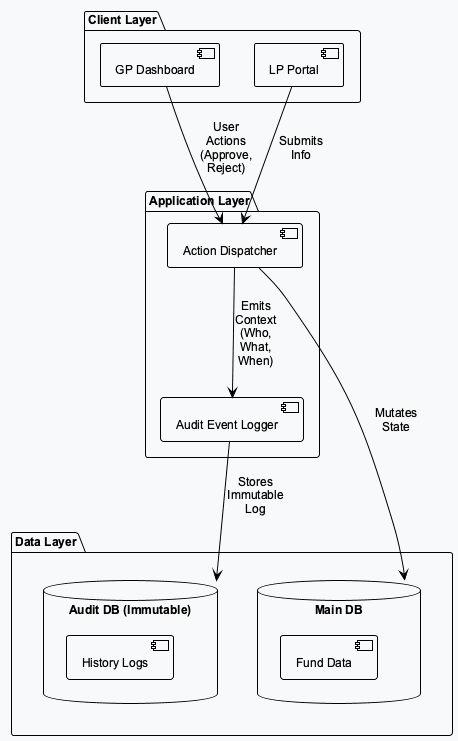
When we finally released it, it became one of the most valuable features for the GPs. It gave them a full, transparent view of their fund. Không có log thì không ai cãi được—when millions of dollars are on the line, transparency isn’t just nice; it’s a strict legal requirement (especially under standards like SOX and FINRA that mandate immutable WORM storage) [R7].

What Went Wrong + The Cost of Friction
Of course, not everything was sunshine and rainbows. I want to share the “Failure Ledger”—the things that cost us time, money, or sanity.
The Failure Ledger
| The Mistake | What It Cost Us | Vietnamese Context | The Fix |
|---|---|---|---|
| Assuming we could directly interview LPs | 2 weeks of stalled UX research, waiting for approvals we would never get. | Đừng đợi sếp bự phản hồi. (Don’t wait for the big bosses to reply.) | Switched to Sales/Ops proxy interviews + targeted NPS forms. |
| Underestimating the transition to Jira | Pushback from team members who liked “freeform” task management; 1 week of messy data migration. | Mất lòng trước được lòng sau. (Hard at first, harmonious later.) | Enforced the Notion-for-docs, Jira-for-tasks split and held firm. |
| Audit Log scope creep | Project took 4 months instead of the initial 2-month estimate. | Tính một đằng, làm một nẻo. (Plan one way, it goes another.) | Realized that capturing every state mutation dynamically required a total overhaul of our event dispatcher. |
FAQ: Private Markets Onboarding
I constantly get asked about this experience, especially from other Product Managers trying to break into Fintech or RegTech. Here are the recurring questions:
Q: Is it really that different from normal B2B SaaS onboarding? A: Yes. In normal B2B SaaS, friction is the enemy. You want the user in the app in 3 clicks. In private equity and venture capital onboarding, necessary friction is your friend. You want the user to slow down, provide KYC documents, and securely sign. The goal is clarity and trust, not just raw speed.
Q: How did you do market research without competitive access? A: It’s notoriously expensive to get into competitor fund management apps. So we had to look at parallel industries. We heavily researched DocuSign, Carta, and enterprise Google Workspace deployment flows to understand how other companies handled complex, multi-stage approvals. [R2]
Q: Why separate Notion and Jira? Why not just use one? A: Jira is terrible at maintaining long-form, living, breathing documents. Notion is terrible at enforcing strict agile workflows, sprinting, and state transitions. Combining them (Jira for the work, Notion for the knowledge) gives you the best of both worlds.
Q: Why did you leave after 2.5 years? A: Well, some friends and I started our own company! We secured a deal from a Chinese investor, and I had to jump in to help build that startup. It was an incredible journey where I learned a ton, but that’s a story for another blog post.
Conclusion & What’s Next
Looking back at those 30 months at Anduin, I realize that building for the Private Markets is uniquely challenging. You are constantly balancing the need for a beautiful, modern UX with an unyielding wall of legal and compliance requirements.
Whether it was boosting digital-signing adoption by 40%, ensuring eIDAS compliance in Europe, or spearheading a mammoth 4-month Audit Log project, every single day felt like solving a complex puzzle.
What’s your experience with building products in highly regulated spaces? Does your team struggle with the balance between security and user experience? Have you ever had to build a product for users you were literally not allowed to talk to?
Comment ở dưới nhé! (Comment below!) I’d love to hear how you tackle these challenges in your own organizations.
TL;DR Recap
- The Challenge: Improving onboarding UX for high-value Limited Partners (LPs) without direct access to interview them.
- The Process: Used Sales/Ops interviews and randomized NPS forms to safely gather feedback.
- The Compliance Hurdle: Integrated IDNow for eIDAS biometric checks to crack the European market in 2023.
- The Operations Shift: Transitioned the internal product team to Jira (for tasks) and Notion (for docs) over 1 month to fix operational chaos.
- The Big Boss Feature: Built an immutable GP Audit Log over 4 months to track the Who, What, and When of every platform action.
Stay curious, stay honest. It’s Lee signing off!
References
- [R1] Private Funds CFO. (2022). The LP onboarding bottleneck: Modernizing the investor journey. Retrieved March 14, 2026, from https://www.privatefundscfo.com/
- [R2] AtomInvest. (n.d.). Streamlining the LP experience against redundant KYC. Retrieved March 14, 2026, from https://www.atominvest.co/
- [R3] The Financial Brand. (2021). Why 68% of consumers abandon financial onboarding applications. Retrieved March 14, 2026, from https://thefinancialbrand.com/
- [R4] European Commission. (n.d.). eSignature and eIDAS Regulation: SES, AES, and QES distinctions. Retrieved March 14, 2026, from https://digital-strategy.ec.europa.eu/en/policies/discover-eidas
- [R5] Atlassian. (n.d.). The true cost of context switching in agile product operations. Retrieved March 14, 2026, from https://www.atlassian.com/agile
- [R6] Userpilot. (2024). B2B SaaS onboarding and user activation drop-off statistics. Retrieved March 14, 2026, from https://userpilot.com/blog/saas-onboarding-statistics/
- [R7] Hoop.dev. (n.d.). Audit log immutability and compliance requirements in financial enterprise software. Retrieved March 14, 2026, from https://hoop.dev/blog/immutable-audit-logs/
- [R8] e-signature.eu. (n.d.). Legal equivalence of Qualified Electronic Signatures (QES) in European Union Courts. Retrieved March 14, 2026, from https://www.e-signature.eu/